PAC ART
PAC ART residency February-August 2026
Jennifer Teets
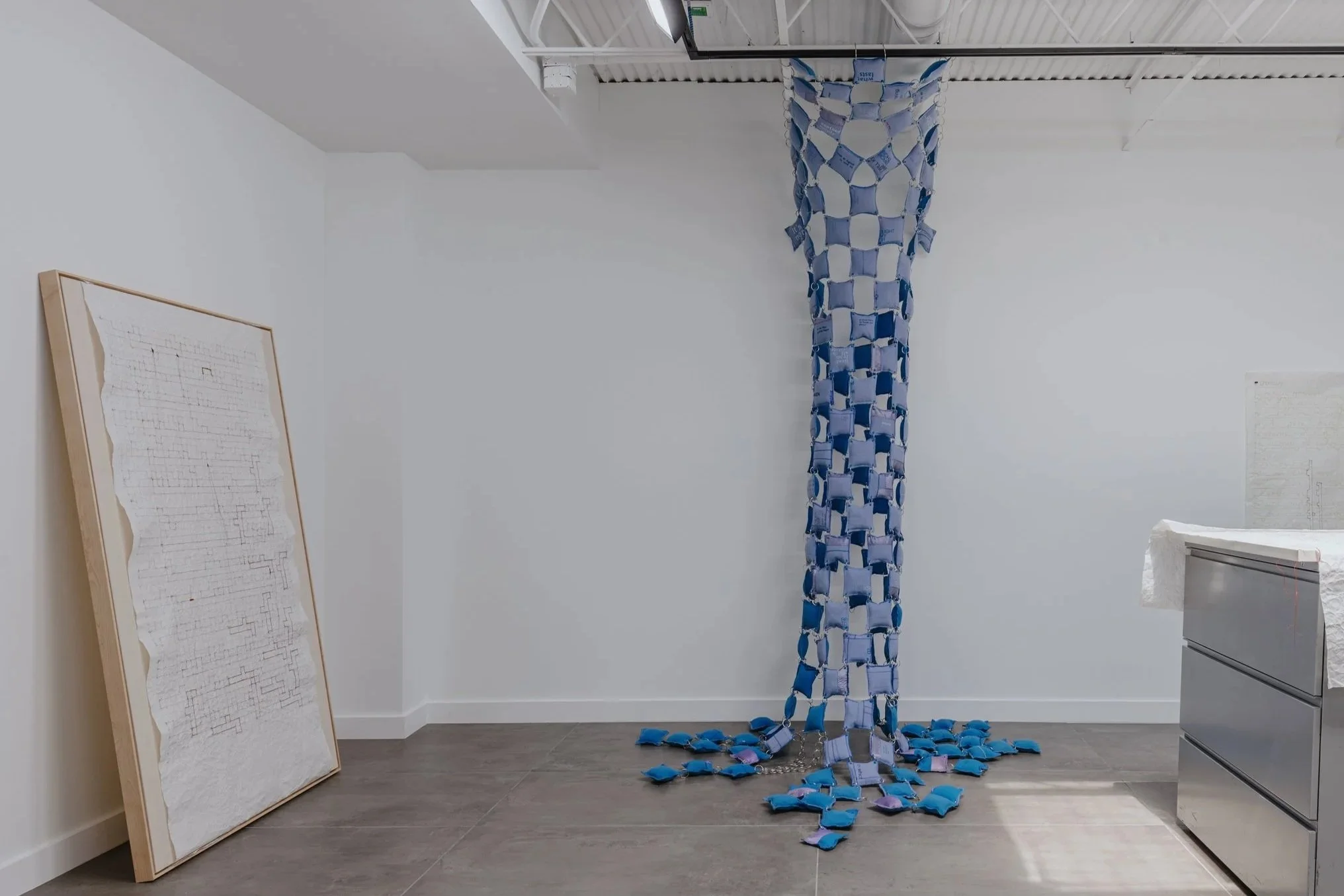
Roslyn Dupré makes work about the moment language stops being language. Her practice — rooted in the somatic labor of the studio, in the sustained physical negotiation between text, material, and body — proceeds through a series of transformations that are as much about undoing as they are about making. Using mulberry paper, thread, a drop spindle, and a sewing machine, Dupré submits language to processes of distortion and repetition until words lose their communicative function and become something else entirely: pure form, bodily residue, the trace of a gesture performed over and over until meaning gives way to texture.Her word maps, produced by gridding and re-gridding textual excerpts — often drawn from multiple voices or sources, sometimes from a single poem — enact what she describes as a washing process. The text is not illustrated or interpreted so much as physically exhausted, worked through the hands until it sheds its semantic freight and becomes available as visual and tactile material. The sewing machine is central to this: turning the mulberry paper under the needle, leaving it in at tight curves, the lagging edge perpetually crumpling, the whole surface accumulating the stress of its own making. The finished work is a record of process — not a representation of something prior, but the direct inscription of a body moving through time. Dupré's choice of mulberry paper is not incidental; the more it is manipulated, the more it behaves like fabric, draping and yielding in ways that mirror the semantic yielding she is after. Paper becomes cloth. Language becomes form.Running alongside the word maps is Dupré's work with Spanish moss, which moves in a complementary but opposing direction. Where the word maps take language and drive it toward abstraction, the moss work takes something that carries no linguistic meaning and draws it toward the edge of legibility — spinning it, through a drop spindle, into configurations that begin to resemble glyphs, alphabets, systems of notation. Viewers find themselves searching for a code that is not quite there, hovering at the threshold of readability. The two bodies of work thus frame the same question from opposite sides: how much can form bear before it becomes language, and how much can language bear before it ceases to be itself? Between them, they define the territory Dupré has claimed as her own.This territory is also, she suggests, a deeply personal one. Dupré describes herself as someone who consumed language before she could produce it — a reader and a listener before a speaker, someone for whom the facility with words felt like an acquired competency rather than a native one. The studio practice that has emerged from this history is less a means of expression than a means of translation: taking the noise of thought and feeling and running it through the body, through the hands, through physical materials, until it becomes manageable — until it becomes something that can be held.