Case study: Sargasso Sea
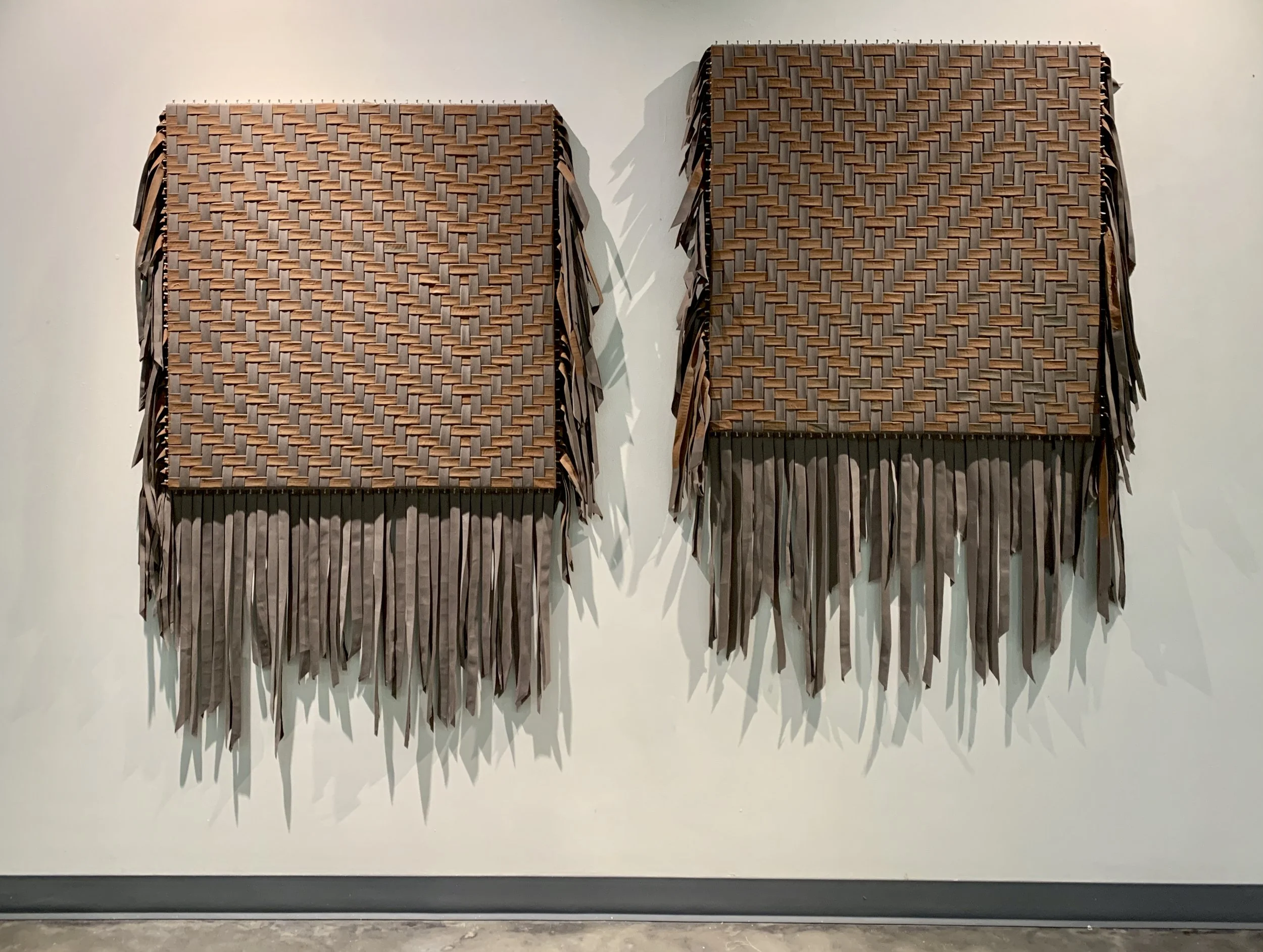
Sargasso Sea. Polyester, oil clay, aluminum push pins; 2 panels, 48” x 48” each: 2022.
Cydney Pickens, Curator
Houston Center for Contemporary Craft
November 15, 2022 - January 15, 2023
The woven fibers that compose the two panels in Sargasso Sea (2022) represent the complex, interwoven histories of race, diaspora, and identity that Dupré investigates in her multidisciplinary practice. The artist pulls from critical literature to examine themes of feminism, racial inequity, and undervalued labor through Sargasso Sea, whichclaims its title from Jean Rhys’ 1966 novel, Wide Sargasso Sea, a postcolonial and feminist prequel to Charlotte Brontë’s Jane Eyre (1847).
Rhys’ novel recenters the narrative on an auxiliary character in Jane Eyre, Bertha, the so-called “mad” wife of Mr. Rochester, Jane Eyre’s love interest. In Rhys’ retelling, Bertha is a more complex and well-rounded character named Antoinette Cosway, a creole heiress. Rhys’ novel unpacks the character’s “madness” to explore concepts of assimilation, racial belonging, and Caribbean history. The creolization of the New World is an important topic in Rhys’ novel as well as within Dupre’s identity as an artist.
Creole refers to mixed European, African, and sometimes Indigenous American ancestry, historically settled in and around the Caribbean. Creole culture is predominant in areas of Louisiana, particularly in New Orleans, where Dupré spent a large part of her adolescence. These disparate histories and identities are interwoven beyond distinction in the New World, which inspired Dupré’s woven panels crafted from bias tape. Bias tape is a material that is used to bind raw edges or the borders of textiles such as clothing hems or quilts. Dupré paints the surface with an oil-based clay that mimics the unique color of Sargassum, a type of seaweed only found in the Sargasso Sea, located in the Atlantic Ocean off of the East coast of the United States. The sea is fed by four directional currents and is not bound by land masses, making it a mysterious region where ships stagnate and sargassum flourishes. The Bermuda Triangle, a notorious area where ships and passengers have been known to disappear, is also associated with the Sargasso sea
Dupré’s fascination with Rhys’ novel and the Sargasso sea itself can be attributed to the entrenched histories and rhetoric of the Trans-Atlantic slave trade. Much has been lost, washed away, or uniquely preserved as people and cultures were forced to share space and create a new way of life. Sargasso Sea (2022) does not attempt to resolve questions regarding creolization but instead poses one to the audience, “What more do you see the longer you stare?”
